





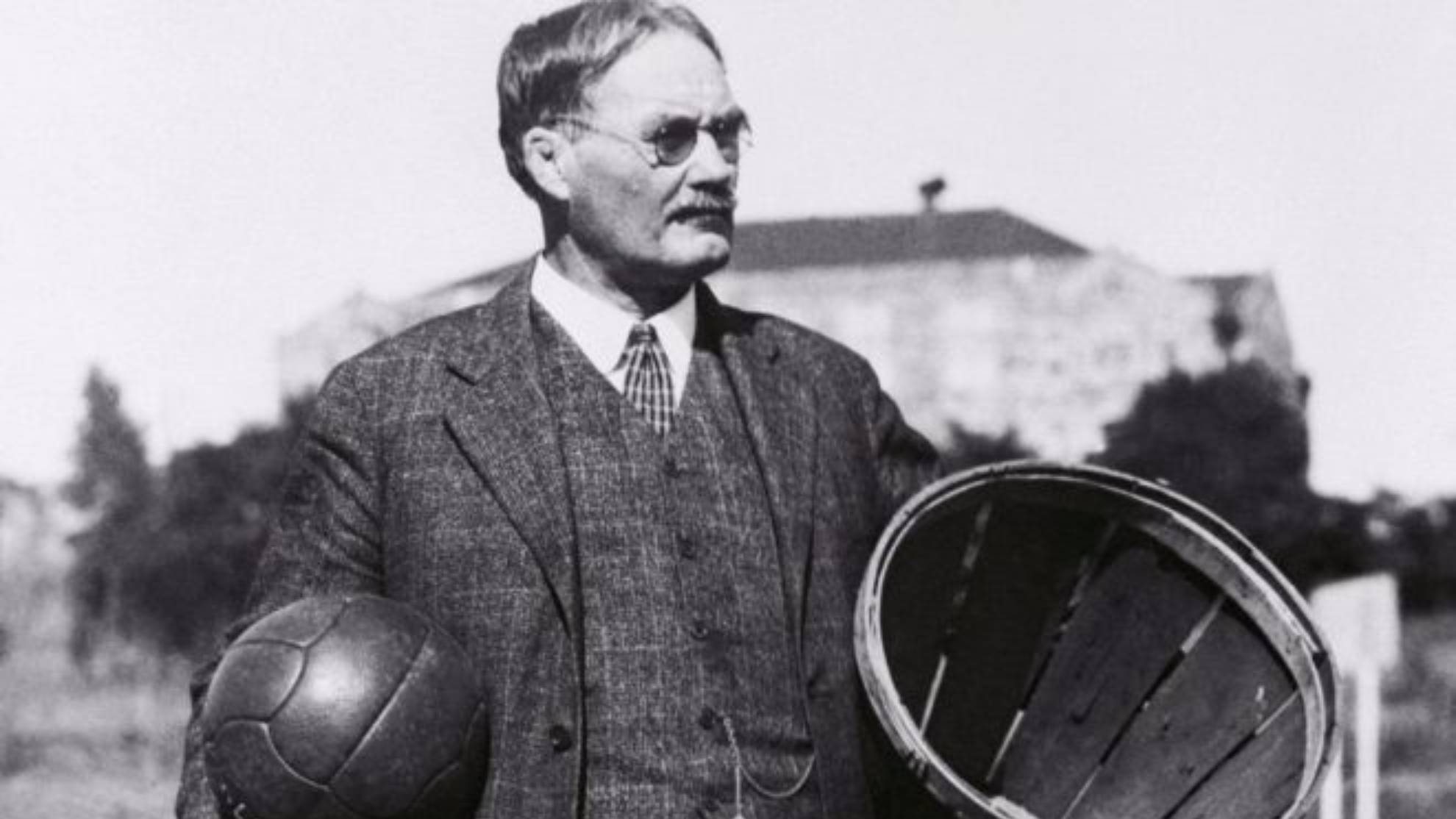
Today, basketball is one of the most played and followed sports on the planet. From the urban courts to the major professional leagues, millions of people live it with passion. However, its origins are much more humble and curious than many imagine. In this article we review the history of basketball, from its creation by James Naismith in 1891 to its evolution as a global phenomenon.
The context: winter of 1891 in Massachusetts
It was December in Springfield, Massachusetts. Winter was especially harsh and the students at Springfield College (then the International YMCA Training School) needed a physical activity to channel their energy without going outside.
The center’s director gave the task to a young Canadian physical education teacher: James Naismith. His goal was clear: to invent an indoor game that could be played indoors, was dynamic, motivating and safe.
James Naismith: the creator of basketball
James Naismith, born in 1861 in Almonte (Ontario, Canada), was a physician, theologian and teacher. He was inspired by traditional children’s games such as “Duck on a rock” (throwing at a target) and existing sports such as rugby and soccer.
In just two weeks he designed the first 13 rules of basketball and hung two peach baskets 10 feet high, one at each end of the gymnasium. He used a soccer as a ball and the first basketball game in history was born: December 21, 1891.
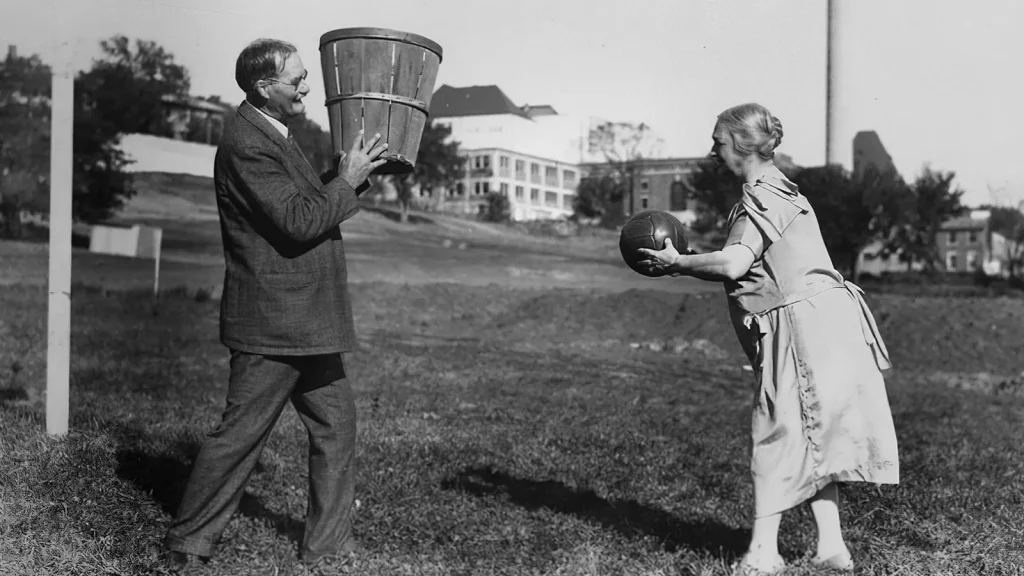
The 13 original rules (1891)
-
The ball can be thrown in any direction with one or both hands.
-
The ball can be hit in any direction, with one or both hands, but never with the fist.
-
A player may not run with the ball. You must throw it from the place where you receive it, except if you are running at high speed.
-
The ball must be held between the hands. Neither the arms nor the body can be used to hold it.
-
It is not allowed to charge, push, hit or trip an opponent. The first infraction is considered a foul; the second may result in disqualification.
-
Consecutive fouls by a team (three without the opponent committing any) award a point to the opposing team.
-
A basket is scored when the ball enters the basket and stays in it, provided it has not been touched by an opponent. If it stays at the rim and an opponent moves the basket, it counts as a point.
-
When the ball leaves the field, it is thrown back into play by the first player to touch it. If there is a dispute, the umpire throws it. The thrower has five seconds to do so.
-
The player has five seconds to serve. If it takes longer, the ball passes to the opposing team.
-
The foul judge records infractions and has the power to disqualify repeat offenders.
-
The general referee controls the ball and keeps the time of the match. It decides when there has been a point, when the game starts and ends, and other general questions.
-
The match is divided into two 15-minute halves with a 5-minute break in between.
-
The team that scores the most points wins. In the event of a tie, an extension may be agreed upon.
First matches and rapid expansion
The first official game was played with 9 players per team, as there were 18 students in the class. Despite its simplicity, the game was a huge success among the students.
Within months, basketball spread to other YMCA schools in the United States and Canada. By 1893, games were being played in Europe (France and England), and by 1900 basketball had reached Asia and Latin America.
Naismith never sought personal recognition. In fact, he died without knowing that his invention would become one of the pillars of world sport.
First organized competitions
United States
- In 1898, the first professional league was created: the National Basketball League (NBL).
- In 1936, basketball debuted as an Olympic sport at the Berlin Games, where Naismith was present as a guest of honor.
Internationalization
- FIBA (Fédération Internationale de Basketball Amateur), the world governing body, was founded in 1932.
- During the 20th century, basketball expanded to all continents, integrating national teams, clubs and regional tournaments.
The NBA and the ultimate professionalization
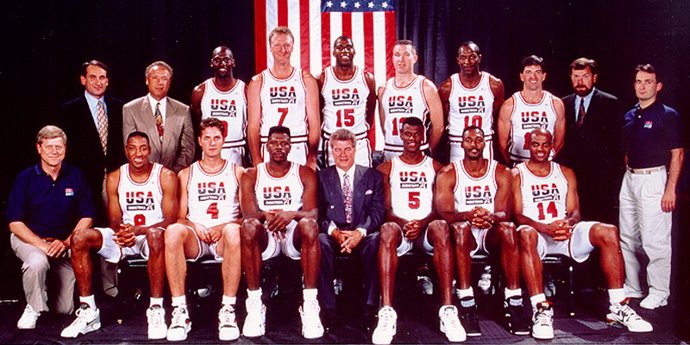
The great global impulse came with the creation of the NBA (National Basketball Association) in 1946, in the United States. From then on, basketball became a spectacle.
Figures such as:
- Bill Russell (11 rings),
- Magic Johnson (revolution of the game in the 80’s),
- Michael Jordan (globalization in the 90’s),
- Kobe Bryant, LeBron James, Stephen Curry…
They turned basketball into a planetary brand.
The NBA expanded to Europe, China and Africa, and today is one of the most influential sports leagues in the world.
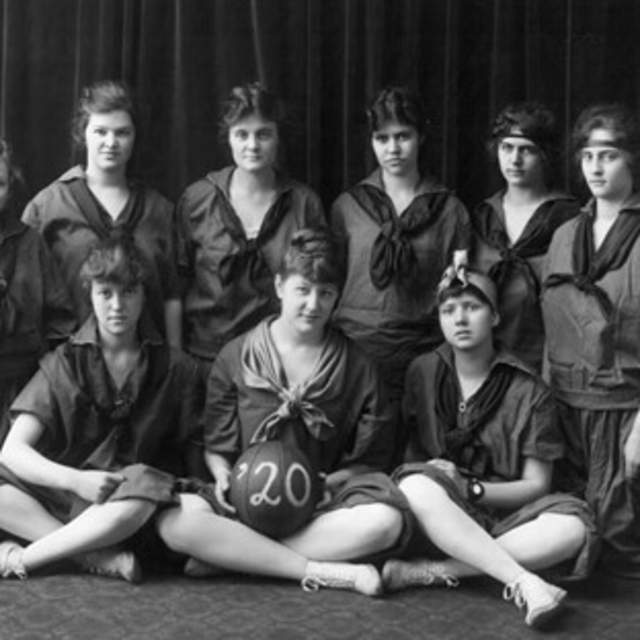
Women’s basketball: another fundamental pillar
Just one year after its invention, in 1892, women began playing basketball. The impetus was led by Senda Berenson, a professor at Smith College.
Today, the WNBA (Women’s National Basketball Association) and international tournaments such as the FIBA World Cup or the Women’s Olympic Games have raised the competitive level and visibility of the sport in its female version.
Basketball at the Olympic Games
Since its inclusion in 1936, basketball has remained one of the most watched disciplines at the Olympic Games. The United States has historically dominated, although teams such as the former Yugoslavia, Argentina, Spain and France have left their mark.
In recent years, 3×3 basketball, which is more urban, fast and accessible, has also been incorporated, increasing the reach to new audiences.
Cultural and social impact
- Basketball has been, and is, a powerful tool for integration, education and cultural expression.
- In the U.S., he has played a key role in the struggle for civil rights (Bill Russell, Kareem Abdul-Jabbar).
- In poor neighborhoods around the world, the courts are a symbol of opportunity.
- In Africa and Asia, the NBA has launched training and social development programs.
Basketball historical curiosities
- In the first games there was no rebound after the basket: you had to climb a ladder to retrieve the ball.
- The first official basketball was manufactured in 1894 by Spalding.
- The three-point shot was not introduced until 1979 in the NBA and 1984 in FIBA.
The legacy of James Naismith
James Naismith was not looking for fame, but for a pedagogical solution. Today, his creation has surpassed all expectations:
- It is played in more than 200 countries.
- It is practiced by more than 450 million people.
- It is a global language that unites people regardless of origin, religion or language.